

You know that feeling when you’re staring at a box of stuff you actually care about? Not the kitchen gadgets you never use, but the real stuff. Grandma’s weird ceramic bird. The glasses your friend bought you for your wedding. That heavy marble thing your kid made in art class that you’re legally required to keep forever.
Most people grab bubble wrap. I get it. It’s right there at the store, it’s easy, and popping it is weirdly satisfying. But here’s the thing nobody tells you about moving day – bubble wrap is just the beginning, and honestly? It’s not even the best tool for half the stuff you own.
I’ve moved more times than I’d like to admit, and I’ve broken enough things to learn the hard way. Let me save you some trouble.
The problem with bubble wrap
Bubble wrap is great for one thing – wrapping things that are already pretty sturdy but might get scratched. Like a laptop. Or a blender. Things that aren’t going to shatter if you look at them wrong.
But here’s what bubble wrap doesn’t do well – it doesn’t fill empty space. You wrap your grandmother’s delicate teacup in bubble wrap, drop it in a box, and there’s still air around it. Air means movement. Movement means cracks.
I learned this the hard way with a set of wine glasses back in 2019. Wrapped each one carefully. Packed them standing up. Closed the box feeling proud of myself. Opened it a week later and found three stems snapped clean off. The glasses hadn’t moved. But the box had. And that’s all it takes.
What actually works
So what should you use instead? The answer is sitting in your laundry basket right now.
- T-shirts and towels are genuinely better than bubble wrap for most fragile stuff. They’re soft, they grip the item so it doesn’t slide around, and you were going to pack them anyway. Wrap a vase in three t-shirts and suddenly it’s not a vase anymore – it’s a soft bundle that happens to have something breakable inside.
- Socks are perfect for wine glasses. Slip a sock over the bowl of the glass, twist the bottom, and tuck it into the toe. Takes ten seconds and your glasses won’t break. I’ve done this for four moves now and haven’t lost a single one.
- The dishware trick that changed my life – stack plates vertically, not horizontally. Think about how records are stored. Same idea. When plates are stacked flat, all that weight is pressing down on the bottom plate. Stand them on their edges and the pressure spreads out. Game changer.
The box within a box
If you’ve got something you’d actually cry over losing, do this instead.
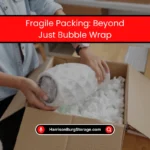
Get two boxes. One small, one bigger. Pack the fragile thing in the small box with as much soft stuff as you can cram in there. Shake it. If you hear anything move, add more soft stuff.
Now put that small box inside the bigger box. Fill the space between them with newspaper, packing peanuts, random clothes, whatever. You’ve just created a shock absorber. The outer box takes the hit. The inner box floats safely inside.
Sounds like overkill until it’s your mom’s wedding china we’re talking about.
The newspaper myth
Someone needs to say this – newspaper ink transfers. It just does. Wrap white ceramics in newspaper and you’ll be cleaning gray smudges off them for years. Use plain packing paper or just use your regular towels and sheets. You’re moving them anyway. Might as well let them earn their keep.
Also newspaper doesn’t cushion much. It’s better than nothing but barely. Crumple it up loosely to create air pockets or use it as filler between boxes. Don’t rely on it to protect anything fragile.
What goes where
Here’s a packing order that actually works for fragile stuff:
- Bottom of the box – heaviest small items. Think books, small kitchen appliances.
- Middle – medium fragile. Plates, bowls, picture frames wrapped in towels.
- Top – most fragile. Glasses, ceramics, decorative stuff.
- Fill every single gap with something soft. No empty space allowed.
And label those boxes. Not just “kitchen” but “FRAGILE – glasses this way up” with an arrow. Future you will be very grateful when you’re digging through boxes at 10pm looking for a coffee mug.
The storage reality
Here’s something nobody mentions – storage units get moved around. Not by us necessarily, but by you. You’ll go in there next month to grab your winter coat and you’ll shift boxes around. Maybe you stack something on top of that box you packed so carefully. Maybe it tips over. Maybe you’re in a hurry and just shove it back.
Good packing survives bad handling. Great packing assumes bad handling is going to happen.
At our storage facility, we see people come in with boxes that looked fine when they dropped them off. Three months later the boxes are squished, the tape is loose, and whatever was inside is now a pile of pieces. Almost always because they relied on one layer of bubble wrap and called it done.
The tape situation
While we’re here – use enough tape. Not just one strip across the top. Seal those seams. Tape the bottom better than you think you need to. Boxes that fall apart in storage are boxes that get their contents crushed. A roll of packing tape costs three bucks. A replacement vase costs way more.
Also write on the tape. Use a sharpie right on the tape to label what’s inside. When the box inevitably gets turned around, you’ll still know it’s the Christmas ornaments and not the camping gear.
The temperature thing
Storage units get hot and cold. Not humid necessarily, but temperature swings happen. Bubble wrap expands and contracts with temperature changes. That tight wrap you did in October might be loose by February. If your items aren’t also secured with filler material, they’ll shift.
This is another reason towels and clothes work well – they don’t care about temperature. They stay exactly where you put them.
One last thing
You’re going to have stuff you’re not sure about. The weird lamp from your college apartment. The decorative plate your aunt gave you that you’ve never liked but feel guilty getting rid of. The random crystal thing from someone’s wedding.
Pack it anyway. Pack it like you care about it. Because six months from now when you’re setting up a new place or just going through your storage, you’ll open that box and either find something intact or find a mess of broken pieces. The effort you put in now determines which one happens.
We’ve got your stuff safe in our facility. Climate controlled, secure, the whole deal. But we can’t control how it’s packed. That part’s on you. Pack smart, use what you’ve got, and skip the bubble wrap obsession. Your stuff will thank you.
And if you need boxes or packing tips, ask us when you come by. We’ve seen every packing mistake in the book and a few that aren’t. Happy to share what works.








0 Comments